Five Hundred Years of the English New Testament


A guest post by Peter Michael Sheehan MacDonald
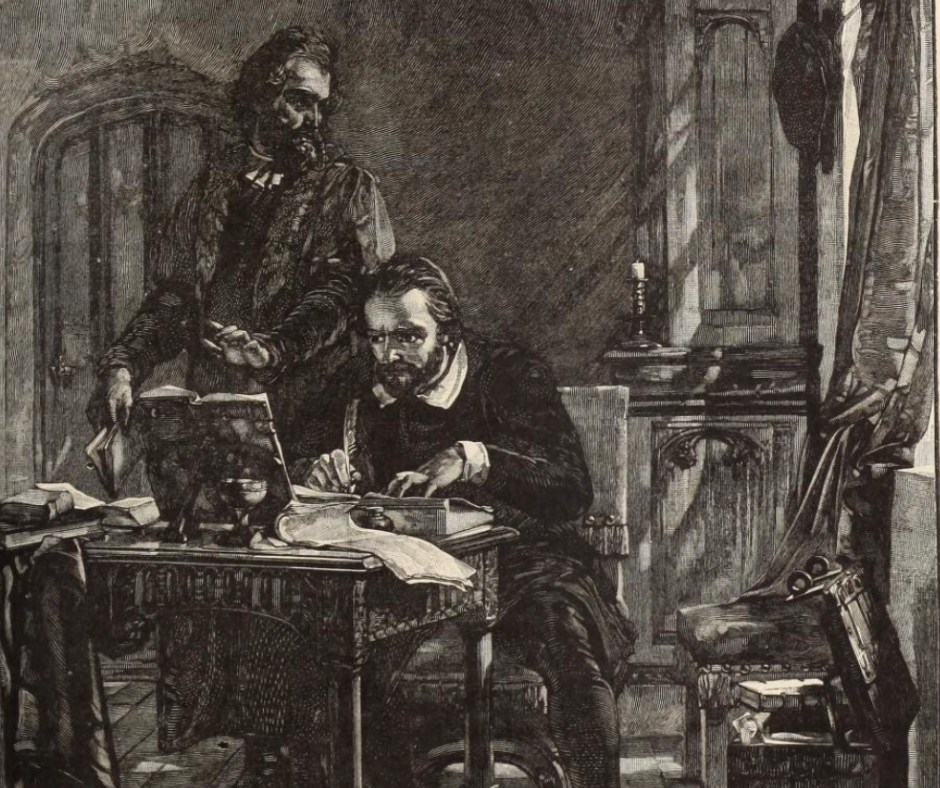
William Tyndale grew up near Cheltenham, England, during a time of profound religious unrest. The memory of the early Christian reformers such as John Wycliffe and Jan Hus, who had dared to challenge the authority and what they believed to be theological error within the medieval church authorities, had not entirely disappeared from England. As Tyndale matured, these earlier calls to return Scripture to the people found new expression in the Reformation, setting a fire in his heart for the Word of God.
Gifted with a sharp intellect and a remarkable talent for languages, Tyndale flourished when sent to university. At Oxford, and later Cambridge, he mastered Latin, and with further study acquired Hebrew and Greek, the original languages of the Scriptures. This training was no accident, it prepared him for a divine calling far beyond academia.
Tyndale’s passionate preaching and sharp theological insight soon attracted the attention of the church hierarchy. His open-air discussions of Scripture with students, grounded not in Latin tradition but in the original Word of God, alarmed the Bishop of London and other authorities. He applied for official permission to translate the Bible into English but was flatly denied. He was warned that any attempt would endanger his life.
But Tyndale was undeterred.
Reformer on the run
Inspired by Martin Luther’s German Bible, which had spread among reform-minded scholars, Tyndale knew what he had to do. He left England in 1524 and travelled to Wittenberg, where it is possible he met Luther personally, as he was deeply inspired by Luther and the wider Reformation movement. With this influence, and with encouragement from Reformation networks and sympathetic printers, Tyndale began the bold task of translating the New Testament into English, not from Latin, but directly from the Greek.
A sympathetic Reformation-minded merchant, Humphrey Monmouth, had earlier hired Tyndale to tutor his children, but in reality provided him with a safe haven where he could begin his translating work. This pattern of hidden patronage and urgent movement continued throughout his years in exile across Germany, Belgium, and the Low Countries. Tyndale was constantly on the move, staying one step ahead of agents sent by the Bishop of London and English authorities.
Tyndale arrived in Europe in 1524, and within just two years, by March 1526, he had completed and printed the first English New Testament translated directly from the Greek. It was printed in Worms, Germany, by sympathetic Reformation printers. The books were smuggled into England hidden in bales of cloth, sacks of grain, and barrels of merchandise, flooding the country with thousands of Bibles in the English vernacular, the Word of God in a language the people could finally understand.
In 2026, we mark the 500th anniversary of this world-changing event, the arrival of the first English New Testament translated from the original Greek not by a committee, but by one man moved by conviction and guided by God.
Influencing English
But Tyndale’s influence did not stop at theology. William Tyndale did more to shape the English language than most later writers. Phrases we now take for granted, “let there be light,” “the powers that be,” “the signs of the times,” “filthy lucre,” “my brother’s keeper,” and “fight the good fight,” were all Tyndale’s. His Bible did not just bring God’s Word to the common man and woman, it forged the rhythm and clarity of modern English. His language became deeply embedded in the spiritual and moral vocabulary of English-speaking people for centuries.
For over a decade, Tyndale continued his translating work in secret, constantly updating and refining his New Testament while also working on the Old Testament. He lived under constant threat but continued his work with determination and faith.
Tragically, his mission was brought to an end by betrayal. A man named Henry Phillips, an opportunistic criminal, was employed by the Bishop of London to locate and capture William Tyndale. Pretending to be a friend, Phillips gained Tyndale’s trust and carefully set a trap. He invited Tyndale to dinner, where enforcers lay in wait, and there he was arrested.
In 1536, after more than a year of imprisonment, Tyndale was tried and convicted. He was strangled and then burned at the stake. His final words, reportedly, were: “Lord, open the King of England’s eyes.”
God answered that prayer.
Translation legacy
Though Tyndale was not widely recognised in his lifetime, scholars estimate that around 80–90 percent of the New Testament of the King James Bible published in 1611 came directly from Tyndale’s translations. The 47 scholars commissioned by James I drew heavily on Tyndale’s work, especially in the New Testament. Even portions of the Old Testament he translated were incorporated, though he was never able to complete it.
Tyndale’s life, along with that of fellow Reformers such as John Frith, became part of the foundation of the English Bible tradition.
Tyndale once famously said to a cleric, “If God spare my life, ere many years, I will cause a boy that driveth the plough to know more of the Scriptures than thou dost.”
We are all that ploughboy whenever we pick up an English Bible. He kept that promise. And because he did, we read the Bible freely today.
Peter Michael Sheehan MacDonald is a retired veteran and writer whose faith is firmly centred on Jesus Christ and His resurrection. He writes on history and theology on Substack at @reformedchristianapt, and is now devoting more of his time to writing devotionals.
Read more about the English Bible in issue #160 Meet the Anglicans.