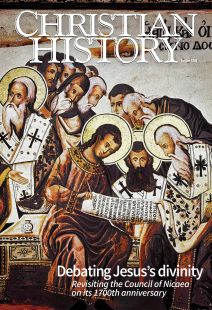
Recommended resources: CH158 Nicaea


Books
Discover an in-depth history of the Council of Nicaea with Y. R. Kim, ed., The Cambridge Companion to The Council of Nicaea (2021). For more on the Nicene Creed itself, its implications and legacy, and how Christians have understood it over the subsequent centuries, see D. H. Williams, Retrieving the Tradition and Renewing Evangelicalism: A Primer for Suspicious Protestants (1999); Christopher Seitz, ed., Nicene Christianity: The Future for a New Ecumenism (2001); Luke Timothy Johnson, The Creed: What Christians Believe and Why It Matters (2003); Lewis Ayres, Nicaea and Its Legacy: An Approach to Fourth-Century Trinitarian Theology (2004); John Behr, The Nicene Faith, Parts 1 and 2 (2004); Khaled Anatolios, Retrieving Nicaea: The Development and Meaning of Trinitarian Discourse (2011); and Phillip Cary, The Nicene Creed (2023).
You can also read about heresies and theological conflicts after Nicaea with Michael Barnes and D. H. Williams, eds., Arianism After Arius: Essays on the Development of the Fourth Century Trinitarian Conflicts (1993); D. H. Williams, Ambrose of Milan and the End of the Arian-Nicene Conflicts (1995); R. P. C. Hanson, The Search for the Christian Doctrine of God (2006); and coming in November, Mark DelCogliano, The Arians: Traditions of Non-Nicene Theology (2026).
Dig deeper into the lives of some of the major players at Nicaea mentioned in this issue with these particular sources. For Origen see Joseph Trigg, Origen (1998); and Jean Daniélou, Origen (2016). On Arius, see Rowan Williams, Arius: Heresy & Tradition (2001). Read about Athanasius in Khaled Anatolios, Athanasius (2004); and John Tyson, The Great Athanasius: An Introduction to His Life and Work (2017). On Constantine see Timothy Barnes, Constantine and Eusebius (1981); Michael Grant, Constantine the Great: The Man and His Times (1994); and Peter Leithart, Defending Constantine: The Twilight of an Empire and the Dawn of Christendom (2010). Discover more on Basil of Caesarea in Stephen Hildebrand, Basil of Caesarea (2014); Gregory of Nyssa with Anthony Meredith, Gregory of Nyssa (1999); and Gregory of Nazianzus in Brian Daley, Gregory of Nazianzus (2006). Church events as documented by the early church historian Eusebius can be read in the modern English edition of his famous work, The History of the Church: From Christ to Constantine (1990). Some of the works mentioned above are a part of a larger series on the early church fathers released by the publisher Routledge—there are currently 23 books in the series.
Learn more about Christian creeds and the practice of the early church in general in W. H. C. Frend, The Early Church (1982); Stuart Hall, Doctrine and Practice in the Early Church (1991); E. Ferguson, ed., Encyclopedia of Early Christianity (1997); Robert Louis Wilken, The Spirit of Early Christian Thought (2003); and J. N. D. Kelly, Early Christian Creeds (2006).
While primary sources for many early church documents are public domain and available at the usual online collections (under “Websites”), see W. H. C. Frend and J. Stevenson, eds., A New Eusebius (2013) for a fabulous collection of 319 early church documents. Pay special attention to Alexander’s encyclical letter warning against the Arian heresy, Arius’s letters to Eusebius of Nicomedia and Alexander, Constantine’s initial letter to Alexander and Arius urging reconciliation, the Canons of Nicaea, Eusebius’s guarded letter to his church in Caesarea following the council, and Constantine’s denunciation of Arius in his observations of the council (as narrated by the church historian Socrates).
Also of interest is Stevenson’s companion volume, Creeds, Councils, and Controversies (2012), which includes excerpts from 236 fourth- and fifth-century documents and follows Athanasius’s battle with Arian emperors (such as Constantius II) until the triumph of Nicene orthodoxy under the emperor Theodosius.
For a helpful companion to church documents from the third through fifth centuries, see Frances Young with Andrew Teal, From Nicaea to Chalcedon: A Guide to the Literature and Its Background (2010).
And just for fun, check out I Believe (Eerdmans Books for Young Readers, 2003), an illustrated version of the Nicene Creed by Pauline Baynes, who did the original illustrations for C. S. Lewis’s The Lion, the Witch, and the Wardrobe and J. R. R. Tolkien’s The Lord of the Rings.
Past CH issues
This issue is largely adapted from CH #85: Debating Jesus’s Divinity. Other relevant issues include:
28: 100 Most Important Events in Christian History
37: Worship in the Early Church
51: Heresy in the Early Church
64: Saint Antony and the Desert Fathers
116: 25 Writings That Changed the Church and the World
Videos from Vision Video
Videos that cover the Nicene Creed include The History of Orthodox Christianity and A History of Christian Worship: Part 1, The Word. You can find out more about Christianity before and during Constantine’s reign in Trial and Testimony of the Early Church and History of Christianity Part I.
Websites
See the usual collections at Christian Classics Ethereal Library, Gutenberg.org, and Internet Modern Sourcebook for access to primary sources. A curated list of Nicene documents with some commentary can be found at Christian History for Everyman; you can also find a comprehensive list of Nicaea resources at Fourth Century Christianity.
Many Christian traditions around the world are celebrating the 1,700th anniversary of the Council of Nicaea with a dedicated online presence, including the Greek Orthodox Archdiocese of America, the Holy See of the Roman Catholic Church, the World Council of Churches, and many more. Along with other study modules on the early church, our own Christian History Institute offers an online study module on the Council of Nicaea.
CH
By the editors
[Christian History originally published this article in Christian History Issue #158.0 in 2026]
Next articles
Did you know: Stories of faith at sea
Facts and anecdotes about Christianity on the seas
the editors
Letters to the editor: Christianity on the Seas
Readers respond to Christian History
Our readers and editors
Editor's Note: Christianity on the Seas
Sea stories and the dynamics of life at sea hold endless dramatic possibilities.
Kaylena Radcliff
The sacramental sea
Scripture often alludes to the ocean
Writers of the Bible as translated by the English Standard Version