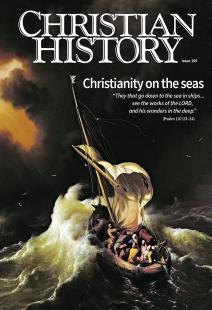
“For those in peril on the sea”


(William Whiting—The Warden and Scholars of Winchester College)
WHILE the most famous hymn associated with seafaring—or at least with a famous seafaring Christian—is no doubt “Amazing Grace,” close behind it in fame comes the 1860 hymn known as the official hymn of both the US and British navies, “Eternal Father, Strong to Save.”
William Whiting (1825–1878), author of “Eternal Father,” was a British choirmaster at Winchester College who grew up near the coast. Unlike another hymn from the same era about God’s love amid tumultuous waters (“It Is Well with My Soul” by Horatio Spafford; see “Did you know?”), “Eternal Father” was not directly inspired by tragedy. Some sources do claim Whiting penned the hymn after surviving a storm at sea, or when a student approached him in fear over an impending sea voyage, or both. As originally written it began:
O Thou who bidd’st the ocean deep
Its own appointed limits keep,
Thou Who dost bind the restless wave,
Eternal Father, strong to save;
O hear us when we cry to Thee
For those in peril on the sea.
Compilers of Hymns Ancient & Modern revised the hymn almost immediately when they published it in their first edition in 1861. They chose to emphasize the strong trinitarian plea, “Eternal Father, strong to save,” by putting it at the beginning (succeeding verses address Christ and the Spirit). Whiting continued to revise the hymn as well; he arrived at the version we usually sing today in 1874. Scriptural references in the hymn include Genesis 1:2, Job 38, Psalms 65 and 107, Isaiah 43:2, and Matthew 8:23–27 and 14:22–33 (see pp. 6–7).
“Eternal Father” has only ever been sung to one tune, MELITA, written specifically for this hymn by clergyman and religious composer John Dykes (1823–1876). (Dykes also composed NICAEA, the tune to which we sing “Holy, Holy, Holy.”) The tune name MELITA comes from another name for Malta, which Dykes chose to commemorate Paul’s shipwreck there. Some hymnologists note that the opening phrase of music makes the shape of a wave.
A NAVY FAVORITE
Both British and American navies quickly adopted the hymn for use in their worship. It was sung in Britain beginning in the 1860s, and the first-known American use dates to 1879, when director of the Midshipmen’s Choir Lt. Cmdr. Charles Jackson Train (1845–1906) began programming it as a regular part of Sunday worship at the Naval Academy. In the past 150 years, it has collected new verses for various branches of the British and American military as well as verses pleading for the safety of travelers over land, sea, and air in general.
These new stanzas include ones praying for the United States Air Force (“Lord, guard and guide the men who fly /Through the great spaces in the sky”), coast guards (“Eternal Father, Lord of hosts, / Watch o’er the men who guard our coasts”), naval submariners (“Lord God, our power evermore, / Whose arm doth reach the ocean floor, / Dive with our men beneath the sea; / Traverse the depths protectively”), and space travelers (“O hear us when we seek thy grace / For those who soar through outer space”). A complete 1937 reworking of the hymn by Episcopal bishop and hymnwriter Robert Nelson Spencer (1877–1961), which preserves most of Whiting’s first and last verses but alters the middle two to pray for protection during land and air travel, is often sung today as “Almighty Father, Strong to Save.”
“Eternal Father” is still sung widely today in religious, military, and civic contexts and has even appeared in movies. It was read into the Congressional Record after the attack on Pearl Harbor and famously used at the funerals of Franklin D. Roosevelt; John F. Kennedy; Richard Nixon; Ronald Reagan; Gerald Ford; George H. W. Bush; Jimmy Carter; Earl Mountbatten; and Prince Philip, Duke of Edinburgh. Though over a century separates us from William Whiting and nearly two millennia from the shipwrecked Paul, we still have reason to trust the mercy of God in the face of danger and to pray: “O hear us when we cry to Thee / For those in peril on the sea.”
By Jennifer Woodruff Tait
[Christian History originally published this article in Christian History Issue #159.0 in 2026]
Jennifer Woodruff Tait is senior editor of Christian HistoryNext articles
Anchored in Christ
Christian care for seafarers in the nineteenth and twentieth centuries
Jason Zuidema


“Let the sea roll high or low”
Christians in the United States Merchant Marine
Christopher A. Graham