

Bosworth, a CORONET, Christ, and Faith Healing


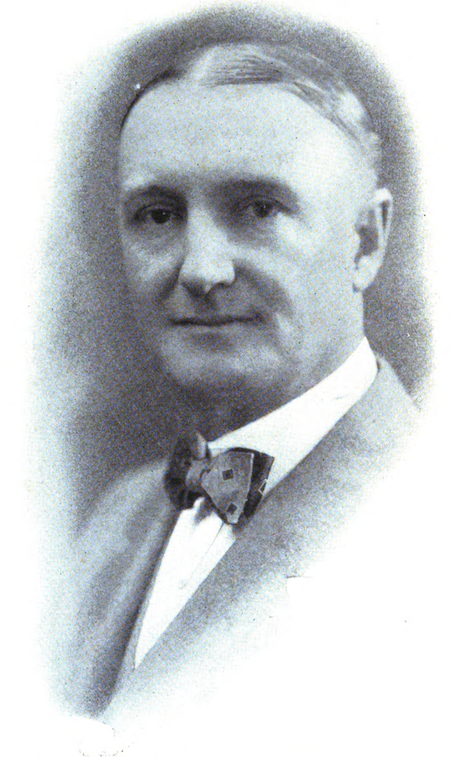
(Fred Francis Bosworth—Frontispiece, Eunice M. Perkins, Joybringer Bosworth, His Life Story, 1921, 1927.)
FRED FRANCIS (“F. F.”) BOSWORTH was determined to succeed, but was restless. He turned from one enterprise to another. Born in Nebraska in 1877, by the time he was nineteen he had been a farm boy, livestock farmer, self-taught cornet player, band member, traveling salesman, factory worker, grocery store clerk, department store clerk, butcher, railroad worker, and house painter.
Music was one thing he never tired of. He first heard a coronet as a boy. He had to have one. Taking a sickly piglet, he nurtured it to health, sold it, and bought a heifer. After the heifer calved, he traded the pair to a neighbor for a cornet and a few instructions. From an old organ book he learned to read music then joined a community band. When his folks moved to University Place, Nebraska, in 1896, he auditioned for the state band and was accepted. Eventually he would make music for the Lord.
Bosworth was about seventeen when a girl invited him to Methodist revival services. On the third night, he went to the altar and asked Christ to become his Lord. Filled with joy he could not quit laughing for hours.
Recognizing that he could not continue making dishonest sales, he found temporary employment in a windmill factory. Several jobs later, he was near death with a lung condition. A doctor diagnosed it as tuberculosis and gave him only months to live. Bosworth boarded a train to say goodbye to his folks who now lived in Georgia. Although he had been so sick he feared he might not make it home, under his mother's care he rallied enough to leave his bed for short outings.
Desiring more of the Lord, he attended a local Methodist revival. Evangelist Mattie Perry heard him cough and told him he was too young to die. God had work for him, she said, and prayed for his healing. Immediately he improved and within days his cough was gone.
He tried barbering, then found work as a postman, was elected town clerk of Fitzgerald, Georgia, lost his bid for re-election by one vote (for supporting a prohibition candidate), and became a bank teller. Meanwhile, he led Estelle Hayde to Christ and they married. Still restless, Bosworth played in and directed the Georgia Empire State Band.
Enticed by reading Rev. John Alexander Dowie’s Leaves of Healing, the Bosworths moved to Zion City near Chicago. Rev. Dowie offered Bosworth a paid position as Zion City’s band leader. The band improved so much under Bosworth's leadership it toured the United States, even playing highly-praised concerts in New York’s Madison Square Garden. Meanwhile under the influence of Christians such as Charles Fox Parham, Bosworth spoke in tongues and was filled with a desire to preach. As Zion City collapsed under the weight of Dowie’s self-aggrandizement and fraud, Bosworth began working with bona fide evangelists.
Eventually, he became an evangelist in his own right. He was a delegate to the meeting that formed the Assemblies of God but in a few years broke with them over their claim that speaking in tongues was the necessary sign of Holy Spirit filling. Had not Paul written, “Do all speak in tongues?” He was affiliated with the Christian and Missionary Alliance, but broke over his belief—which he later abjured—that British and Americans were the lost tribes of Israel. Meanwhile, he conducted some of the largest and most successful faith-healing campaigns in American history.
His evangelism was not without adventures. On this day, 5 August 1911, he was held at gunpoint in Hearne, Texas, and brutally beaten by a drunken mob that accused him of preaching to Blacks. He had to walk many miles carrying his luggage in one hand—his other wrist broken. It was a month before his battered back could comfortably touch a mattress.
Although Bosworth did not show much discernment regarding other ministers—some of his mentors and proteges proved to be frauds—he himself seems to have been faithful and honest, above financial reproach, and not given to embellishing his record or making grandiose claims. His theology of divine healing, expressed in his 1924 book Christ the Healer, was based on a careful examination of Scripture. He considered healing necessary but less important than salvation of the soul. When answering critics he showed a Christian spirit, refuting what they said without mentioning their names or dragging them in the mud.
He died in his eightieth year, smiling and greeting heavenly people who were unseen to the family singing and praying at his bedside.
—Dan Graves
For more about divine healing see CH 142 Divine Healing
Other Events on this Day
- King Oswald Preached the Gospel and Died in Battle
- CUTHBERTSON FOUGHT A BEAR AND RECORDED A WEALTH OF MARRIAGES AND BAPTISMS