Taking care of (church) business


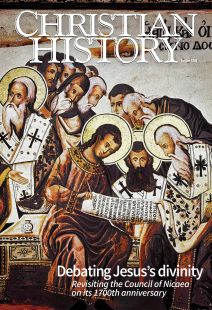
(ABOVE: Illumination of Paphnutius in Menologium of Basil II. Circa 976 to 1000. Vat.gr.1613, p. 66—Biblioteca Apostolica Vaticana / Public domain, Wikimedia)
One of the most vexing problems in the early church concerned when to celebrate Easter. The Greek-speaking Eastern church insisted that it had to be on the date of Jesus’s Crucifixion—Nisan 14, the Jewish Passover—regardless of the day of the week. The Western, Latin-speaking church, on the other hand, decreed that it had to be on the day of the Resurrection—Sunday—regardless of the date. The Council of Nicaea decided that Easter should be celebrated on a Sunday after the Jewish Passover, but the problem did not disappear entirely. Even today the Eastern Orthodox Church, which uses the old Julian calendar, often observes Easter on a different Sunday from the Western church, which uses the Gregorian calendar (see bonus guide of CH, Fasts and Feasts for more).
Another significant issue at Nicaea was a proposal for clerical celibacy, probably introduced by Ossius of Cordoba (pp. 36–39). But this proposal was vigorously opposed by the bachelor bishop Paphnutius. He urged that “too heavy a yoke ought not to be laid upon the clergy” and that “marriage and married intercourse are of themselves honorable and undefiled.” Such a statement coming from a celibate carried the day, and the council stopped all discussion on the matter. (Clerical celibacy was eventually enforced in the 11th century by Pope Gregory VII.)
Nicaea's rules to live by
Twenty formal canons (rules, standards) were also passed at Nicaea. These canons, in contrast to the great theological debates over the person of Christ, are extremely practical rulings—some very minor—on problems in the early church. Many of them resulted from the recent persecution of Christians as well as challenges to episcopal authority:
1. Eunuchs may become clergymen, unless their condition was self-imposed.
2. A period of probation is required before converts can hold church office.
3. No woman is to live in the home of unmarried clergy, except for a mother, sister, or aunt.
4. A bishop must be chosen by all colleague bishops, or at least by three in person, the others agreeing by letter.
5. Anyone excommunicated by a given bishop shall not be restored by others, unless the excommunication was unjust. There will be two synods a year in a given province to determine this.
6. The bishop of Alexandria is in charge of Egypt, Libya, and the Pentapolis, much as the bishops of Rome and Antioch have authority in their domains. Any “bishop” opposed to them is no bishop, according to a majority vote of area bishops.
7. Let the bishop of Aelia (Jerusalem) have the place of honor next after the metropolitan (the bishop of Caesarea. Ever since its destruction in AD 70, Jerusalem was in decline.)
8. Sectarian Cathari (also known as Novatians—they adamantly denied forgiveness to those who fell away during persecution, a position that caused a major church schism) wishing to return to the church must state in writing that they will pardon the penitential lapsed, their offices remaining the same except where the local bishop remains in charge.
9. Whoever are ordained without examination are deposed if later found guilty.
10. Whoever was ordained but had lapsed (earlier, in persecution) shall be deposed.
11. Those who lapsed in persecution without duress but wish readmission and genuinely repent must undergo a 12-year probation (not able to fully participate in the body of Christ, such as in taking Communion).
12. Those who endured violence, then lapsed, are excommunicated for 10 years, but may be readmitted depending on their penitence.
13. The dying (who are not yet communicants) are to receive the Eucharist (on their deathbed), but if they recover, they are to share only in the prayers of the church.
14. If a catechumen has lapsed, he is demoted to hearer status for three years, after which he may pray again with (i.e., rejoin) the catechumens.
15. No bishop, presbyter, or deacon shall “pass from city to city” exercising official authority but shall be returned to the church in which he was ordained.
16. Any presbyters or deacons who desert their own churches are not to be admitted into another but must be returned to their own parishes. If a bishop ordains anyone belonging to another (church) without the consent of that bishop, the ordination is void.
17. Any clergyman lending his money at interest, such as 1 percent (per month) or 150 percent usury for the loan shall be deposed from office.
18. Deacons are to know the limitations of their rank and not administer the Eucharist to presbyters, nor touch it before them.
19. Paulianists (followers of the heretic Paul of Samosata) must be rebaptized, and their clergy reordained if blameless or deposed if not. Their deaconesses are laicized.
20. For the sake of uniformity in the church, on the Lord’s Day and Pentecost all should pray standing rather than kneeling.
CH
By Paul L. Maier
[Christian History originally published this article in Christian History Issue #158.0 in 2026]
Paul L. Maier (1930–2025) was the Russell H. Seibert Professor of Ancient History at Western Michigan University, third vice president of the Lutheran Church–Missouri Synod, and an author. This article is adapted from CH #85.Next articles

Against the world and for the Trinity
We know almost nothing of Athanasius’s early life
Jennifer Woodruff Tait
CH 158 timeline: debating Jesus's divinity
Events that led to the Council of Nicaea and the controversies that came after
the editors
Creed, chaos, and consensus
The rise of the pro-Nicene alliance and Trinitarian understanding
Mark DelCogliano