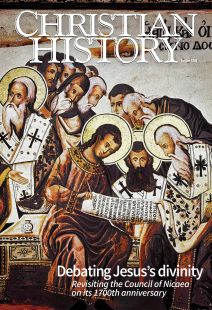
Editor's note: Nicaea


(ABOVE: CHI headquarters)
“I and the Father are one” (John 10:30).
Jesus is God. I have believed this since I came to faith at nine years old. Though I have wondered what exactly that might mean and have certainly puzzled over that mystery, it’s a truth I have never deeply interrogated. It hadn’t occurred to me ask, “Well, how do you know that really?”
It also never occurred to me that what is a settled matter for the modern church was a conundrum for the ancient one. Early believers agreed that Jesus is God, yes—but how? What does it mean when the Bible says he is begotten? Are there degrees of divinity? How is Jesus both God and man?
Debating Jesus's divinity
These sorts of questions led to the historic council that took place at Nicaea 1,700 years ago. Its anniversary in 2025 led Christian History to revisit the story as captured in CH #85: Debating Jesus’s Divinity—as well as add some new fascinating articles, images, and primary sources. (Yes, we’re a little late, but we think the wait was worth it!)
In this refreshed issue of Christian History, you’ll learn more about the discussions, debates, and outright conflict that reached a boiling point in the fourth century between church leaders, such as Alexander of Alexandria and Arius, concerning this all-important question of Jesus’s divinity. You’ll also meet other major players at the council and discover how their involvement led to the creation of the Nicene Creed—Roman emperor Constantine, Ossius of Cordoba, Eusebius of Caesarea, and Eusebius of Nicomedia, to name a few.
You’ll also see how the Nicene Creed wasn’t exactly the “be all, end all” of reflection on church doctrine at the time. In fact its application in the midst of an evolving state and church relationship created more councils, creeds, and conflicts in the decades afterward. But from this chaos emerged the clarifying theological work of church fathers such as Athanasius, Basil of Caesarea, Gregory of Nyssa, and Gregory of Nazianzus—leading the church to a strongly trinitarian consensus and giving us the Nicene legacy we cherish today.
Messy people, sovereign God
Like all real history, the road that led to Nicaea was winding, arduous, and uncomfortably complicated. A consistent tension in Christian history (and one that CH highlights in every issue) is how the undeniable messiness of humanity and the limits of our human understanding operate alongside the sovereign hand and perfect revelation of God. The Council of Nicaea and all that happened before and after serve as a perfect example of that tension.
At the council human events took place at the behest of a questionable political power—people with personal failures and fallible motives were part of a crucial moment in the life of Christ’s church. Some might look at the truths clarified at this council with suspicion, ascribing fault to the details because of the faults in the people involved.
And yet we trust the God in whose hand “the heart of the king is like a stream of water; he directs it wherever he chooses” (Prov. 21:1). At Nicaea he used the people and powers that were there to accomplish his righteous purposes—for his glory and our good. We can trust that in the messiness of the early church, the Spirit pointed us to Jesus and to all that God says about himself through Scripture.
Isn’t this just like God’s grace for each of us? Not one of us came to Christ with a perfect understanding of who he is, but through the Holy Spirit, God grew us—revealing himself to us in his Word progressively, guiding us to know and love him more deeply as we mature. And we have hope that one day, as Scripture promises, we will know him perfectly. As we remember the 1,700th anniversary of the Council of Nicaea, let us hold fast to that comforting grace, trusting that the One who directs kings and councils directs our own hearts to know him better.
CH
By Kaylena Radcliff
[Christian History originally published this article in Christian History Issue #158.0 in 2026]
Kaylena Radcliff Managing editorNext articles
State of Emergency
How the need for doctrinal clarity paved the road to Nicaea
John Anthony McGuckin
Which creed is which?
The “Nicene Creed” used in church hymnals and liturgies is a different creed from the one accepted at Nicaea in 325
D. H. Williams
Do you know whom you worship?
How the Nicene Creed sharpened understanding and confession of the faith
D. H. Williams
“And in one Lord Jesus Christ”
Arguments on the relationship of Father and Son
various ancient authors