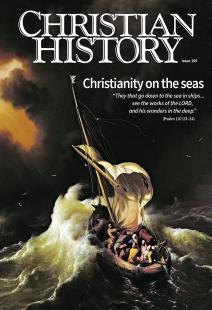
Editor's Note: Christianity on the Seas


When I first began drafting my latest fantasy novel, Tower of Cortico, I began with one image in mind: a wind-powered sailing vessel on the cusp of a spectacular sea battle. I had long been interested in writing an epic sea adventure, and as I began researching, I became obsessed. Sea stories and the dynamics of life at sea hold endless dramatic possibilities. Where else can you so readily be transported to new worlds and be immersed in sublime beauty in one scene and face terrible danger with the weather’s turn in the next?
My fascination isn’t unique, of course. From ocean adventures and romantic depictions of life at sea in literature, film, and music across cultures, it’s clear the sea captures the human imagination. It is a gateway to mystery and discovery, a shaping force in myth and legend, and, for much of human history, a representation of the supernatural. Whether societies believed it was a god itself or under some deity’s authority, its unpredictability made it both an unexpected ally and a formidable foe.
God’s Word gives us the true myth, however—he made the sea, and it belongs to him (Psalm 146:6). Throughout the Bible, this powerful creation communicates aspects of God’s character, such as his sovereignty and providence, through both poetic language and historical narrative that point us to who he is (pp. 6–7). And, throughout history, those whose livelihoods depended on the sea have understood it as a means of both God’s provision and judgment.
GOOD NEWS ON THE HIGH SEAS
Thus it comes as no surprise that the story of the sea is deeply entwined with the story of our faith. In this issue of Christian History, we try to tell part of that great story.
The following pages will take you on a two-millennia sweep through Christianity on the seas. Starting with ancient Jewish roots as well as pagan understandings of the sea, and then Jesus’s authority over the winds and the waves, we move into the following centuries and cover a lot of ground (or rather, ocean). Sail with Paul the apostle in the first century, Brendan the Navigator and other missionary monks of medieval Ireland, William Carey, the Judsons, and more missionaries as they evangelize distant shores. Traverse the Atlantic with colonizer-turned-priest Bartolomé de Las Casas, the faith-driven Puritans, the slaveship captain John Newton, and the Moravian-inspired John Wesley—they, like many who came before and who followed, had to face what they really believed about God when the stormy seas nearly swallowed them.
We’ll also cover the history of ministry to seafarers—those who live out more of their days on the water than on land. In the Western world, starting in the seventeenth century, Christians began to recognize the desperate need for spiritual, physical, and emotional care for sailors. From this need sprang numerous worldwide ministries: land-based lifelines, distribution of tracts, devotionals, and Bibles, and even floating churches.
Chaplains and others cared for sailors’ souls by bringing worship to them—conducting services aboard, writing hymns and devotionals unique to mariners’ needs, and fostering a godly culture among the crew. These ministers became instrumental in reform and revival. Some even gave their lives—sacrificing themselves to save seafarers in the tumult of war, tempest, and other disasters at sea. Finally you’ll get to see how some of these ministries still care for sailors today.
ENTER THE SEAFARING STORY
At any rate there is something for everyone in this issue of CH. Whether you approach the seafaring story with starry-eyed wonder or with grim understanding of its unique dangers, we hope you’ll see a bit of both in the following pages. We also hope you’ll recognize God’s redemptive power at work in the sea—in both the powerful witness of his creation and in the hearts of the men and women who received, carried, and delivered his good news by way of the waters. CH
By Kaylena Radcliff
[Christian History originally published this article in Christian History Issue #159.0 in 2026]
Kaylena Radcliff, managing editor of Christian HistoryNext articles
The sacramental sea
Scripture often alludes to the ocean
Writers of the Bible as translated by the English Standard Version