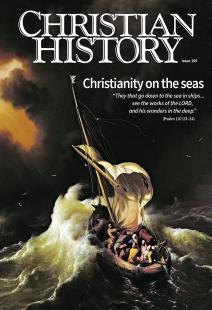
Living waters


(ABOVE: Gemälde von Max Frey (painter), Poseidon and Daughter, 1931—public domain, Wikimedia)
For the Galilean fishermen who first followed Jesus, it was no cheap trick that he could walk on the sea, quell its dangerous storms, or find life-giving catches of fish hidden beneath it. In a world without weather reports, motors, and navigation equipment, the one who could conquer and redeem the sea would have to be extraordinary—perhaps even divine.
SEA GODS AND MONSTERS
For much of human history, the sea was not just alien and dangerous, it was a god. Ancient religions characterized the ocean as a living force—supernatural, wildly powerful, and uncontrollable. In the Babylonian Enuma Eliš (When on High, c. 2000 BC), the Sea (Tiam-at) is the mother of the gods. She is also their first great enemy, and they make the cosmos from her after they defeat her and divide her body up.
In the Greek poem Theogony (Birth of the Gods, c. 700 BC), the Sea is a granduncle of the gods, born directly from the Earth “without loving intimacy.” Zeus gives authority over the Sea to his older brother Poseidon, “He Who Encircles and Shakes the Earth.” Poseidon, characterized by pride and quickness to anger, possesses a sealike fickleness. In Homer’s Iliad (c. 800 BC), Poseidon boasts that his authority over the Sea is equal to Zeus’s over the Sky; he uses storms and sea monsters to punish Odysseus and other seafaring heroes for perceived impieties, often killing their crews in the process.
The Bible, too, often represents the sea as dangerous, although God subdues it. In Genesis he creates the sea by gathering the waters, but creation of the waters is not explicitly mentioned. The Hebrew word tehom, translated as “the deep” in Genesis 1 is similar to the word tiam, as in Tiam-at, which some interpreters have noted with interest. A poetic and similar account of God containing the sea at creation is found in Job 38; Psalm 74 also references God defeating sea monsters and Leviathan (tanninim and liwyatan, both dracon in Greek), dividing up the waters, and creating rivers.
REDEEMING THE DEEP
Given all these traditions, and the evident truth that believer and nonbeliever alike are vulnerable at sea, it is interesting to see how Scripture extends God’s power and mercy over the whole of it so that at its creation God even “saw that it was good.” Jonah, in his determination to see Assyria punished and his reckless endangerment of his fellow seafarers, acted much more like Poseidon than the God who sent him—but those pagan seafarers, confronted by a man who says, “I fear YHWH, the God of the sky, Who made the sea and dry land” and was thrown willingly to certain death, began to fear Jonah’s God anyway.
Paul, too, impressed those he met as he braved shipwrecks in the spreading of the early church. Jesus himself began his ministry with fishers, men plying a dangerous trade on the literal margins of Israelite territory and society. With them we can ask, wondering: “Who is this, then, that he gives commands even to the winds and the water, and they obey him?” (Luke 8:25)
By Kevin William Walker
[Christian History originally published this article in Christian History Issue #159.0 in 2026]
Kevin William Walker, independent researcher in seafarers’ ministry and academic religious studiesNext articles


Faith to face the deep
A look at the traditions that sailing communities carried across the Atlantic
Daniel F. Flores