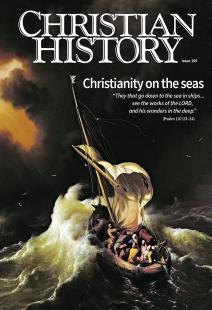
Christian History Timeline: Christianity on the Seas


(ABOVE: Richard Stone (photographer), Ministry of Information Photo Division, A Wren transmitting Messages Using an Aldis Lamp in 1944—Imperial War Museum / Wikimedia Commons)
— c. 2000 BC The Mesopotamian creation myth, Enuma Elish, is recorded, which claims the primordial sea deity Tiamat birthed the first gods.
— c. 750 BC The events of the book of Jonah likely take place during the reign of Israel’s King Jeroboam II.
— c. 30 AD Jesus calms a storm on the Sea of Galilee.
— c. 46 Paul sets out across the Mediterranean Sea for his first mission-ary journey. Christianity spreads to port cities of the Roman Empire.
— c. 60 On their way to Rome, Paul and other prisoners are shipwrecked on Malta after a severe storm.
— 270 Nicholas of Myra is born in the Mediterranean port city of Patara. Legend holds that Nicholas rebukes and calms a storm as he sails to the Holy Land. He is later venerated as a patron saint of sailors and fishermen.
— c. 400s Early medieval sources ascribe the title “Stella Maris” to Mary, the mother of Jesus. Mary becomes an enduring figure in mariners’ religious lives; Stella Maris coastal churches spring up, fostering a strong religious devotion to Mary that continues for centuries.
— c. 484 Brendan the Navigator, an Irish monk and priest, whose legendary sea missions are recorded in the ninth-century text Voyage of Saint Brendan the Navigator, is born.
— c. 550 Columcille (or Columba), an Irish abbot and missionary, sails near Scotland and founds the abbey on the island of Iona. Other Irish monks sail the world and do the same. Masses and Christian practices become common aboard sailing vessels.
— 995 Olaf Trygvasson sails from England back to Norway to become king and convert his people, having earlier been baptized a Christian.
— c. 1180 The Judgments of Oléron, laws governing maritime conduct, require better care of seafarers at the captain’s expense.
— 1444 Portuguese mariners capture Africans along the West Africa coast, initiating a slave trade that eventually crosses the Atlantic Ocean.
— 1492 Christopher Columbus sails west and reaches an island in the Bahamas (the Indies), ushering in the age of exploration. Rapid colonization follows.
— 1502 Bartolomé de Las Casas voyages to the Indies and witnesses the brutal exploitation of the Taíno population.
— 1517 Las Casas sails back to Spain to intercede for indigenous peoples by suggesting importation of African slaves to the Indies.
— 1620 The Mayflower arrives at Cape Cod on November 11.
— c. 1630 Settlers, mostly Puritans, begin to cross the Atlantic for New England in the “great migration.”
— 1662 The Book of Common Prayer is amended to include forms of prayer to be used at sea. Devotional guides and prayer books for sailors begin to circulate widely among crews.
— 1664 John Favel writes Navigation Spiritualized to teach sailors about salvation.
— 1706 German Pietists Heinrich Plütschau and Bartholomäus Ziegenbalg sail to India as missionaries.
— 1721 Hans Egede arrives in Greenland and evangelizes the Inuits.
— 1732 Moravian Brethren Johann Leonhard Dober and David Nitschmann sail to the Virgin Islands to share the gospel, beginning the Moravian missions movement.
— 1736 John and Charles Wesley sail on the Simmonds from England. During a terrible storm, the Moravians on board keep calm and sing psalms, which catalyzes John Wesley’s conversion experience.
— 1738 George Whitefield journeys on the Whitaker and preaches to the crew. He will cross the Atlantic many more times to preach to thousands during the Great Awakening.
— 1748 John Newton nearly dies aboard the slave ship Greyhound during a violent storm, beginning a process of spiritual awakening.
— 1779 The Naval and Military Bible Society forms to distribute Bibles on British naval ships.
— 1793 Missionary William Carey sails to India, entering illegally after being kicked off a British vessel.
— 1796 The London Missionary Society purchases a ship, the Duff, which brings both missionaries and artisans to the South Pacific Islands. Other societies send missionaries by boat all over the world, beginning what is known as the “Great Century of Missions.”
— 1812 Adoniram and Ann Judson sail to India with Samuel and Harriet Newell as some of the earliest American missionaries.
— 1814 Zebedee Rogers leads a prayer meeting with the crew of the Friendship, beginning the Thames Revival.
— 1818 The Port of London Society is founded and purchases the first floating chapel, HMS Speedy. In the next decade, multiple mission societies form to minister to sailors around the world.
— 1839 Anglican clergyman John Ashley purchases the Eirene to minister to mariners living on islands in the Bristol Channel.
— c. 1850 Chaplains aboard US vessels influence morale and alter policies, such as outlawing flogging.
— 1856 Ashley’s work inspires a formal organization, Missions to Seamen Afloat, at Home and Abroad.
— 1860 William Whiting writes “Eternal Father, Strong to Save,” which quickly becomes a favorite naval hymn.
— 1862 John L. Lenhart of the Cumberland becomes the first US Navy chaplain to die in combat.
— 1864 The Norwegian Seamen’s Mission is founded. Other seafarer mission organizations in Scandinavia soon follow.
— 1873 Horatio Spafford writes the hymn “It Is Well with My Soul” after a tragic shipwreck kills his daughters.
— 1892 Evangelist D. L. Moody leads a prayer service aboard the sinking SS Spree.
— 1894 Augustinians of the Assumption found the Société Œuvres de Mer in France to minister to French fishermen.
— 1912 The RMS Titanic sinks in frigid waters on April 14. The ship’s band plays hymns to calm passengers.
— 1913 The Seamen’s Church Institute opens a sailors’ home in Manhattan that accommodates over 500 people.
— 1921 The Apostleship of the Sea is formally founded as a Catholic maritime ministry.
— 1932 The Council of Seamen’s Agencies (renamed North American Maritime Ministry Association—NAMMA—in 1991), forms as a collaborative effort between Christian missions to seafarers in North America.
— 1941 Chaplains A. H. Schmitt and T. L. Kirkpatrick die in the attack on Pearl Harbor.
— 1943 The Dorchester is attacked and sinks near Greenland. Four US Army chaplains sacrifice themselves to minister to the crew.
— 1950 Captain Leonard LaRue rescues 14,000 people with the Merchant Marine vessel, SS Meredith Victory, during the Korean War.
— 1969 The International Christian Maritime Association (ICMA) is founded.
By the editors
[Christian History originally published this article in Christian History Issue #159.0 in 2026]
Next articles
Tempestuous voyages
Stories of transforming faith at sea, taken from past Christian History issues and other CHI resources
various authors

“For those in peril on the sea”
The official hymn of British and American navies
Jennifer Woodruff Tait
Anchored in Christ
Christian care for seafarers in the nineteenth and twentieth centuries
Jason Zuidema